Speed Without Sense: The Promise, Peril, and Proper Place of AI in Business
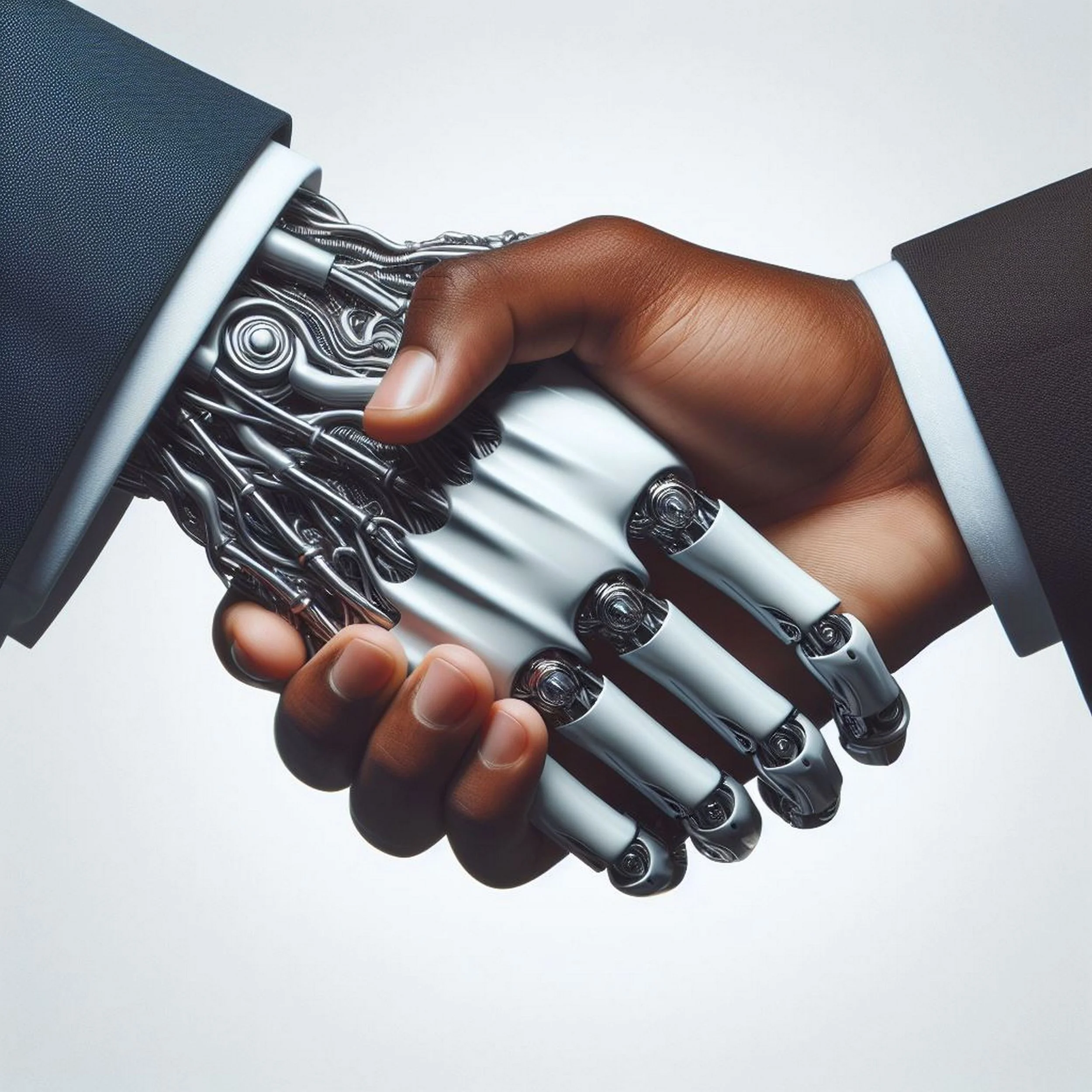
AI - Human Co-operation
Artificial intelligence and machine learning are often spoken about as if they are the same thing, but they operate at different levels of meaning and usefulness, and sometimes, uselessness. Shepherd and Majchrzak (2022) define AI as machines trained to perform tasks associated with human intelligence, learn from external data, and adapt to specific outcomes. Machine learning is one of the main ways that gets done. It uses data and feedback to identify patterns and improve performance over time. So, AI is the broader vision, while machine learning is one of the most practical ways to get there.
That distinction matters because it changes how we think about business value. Machine learning is especially good at compressing the past into prediction. It looks at what has happened before and uses that to estimate what is likely to happen next. AI, more broadly, can do more than predict. It can shape decisions, interactions, and even the way work itself gets organized. That means machine learning is often about efficiency, while AI is often about adaptation. One helps a business get sharper. The other helps it get smarter.
A creative way to think about this is that machine learning is the business version of memory, while AI is the business version of judgment under pressure. Memory is useful, but memory alone does not tell you what to do when the situation changes. That is why the relationship between AI and machine learning is not just technical. It is strategic. Businesses that confuse the two may end up using a powerful tool for the wrong kind of problem. There’s actually a name for this tendency: Maslow’s Hammer. It’s a classic mental shortcut, and it’s more common (and more dangerous) in the corporate world than we’d like to admit.
Tangent incoming:
Back in 1966, Abraham Maslow famously said, “If the only tool you have is a hammer, it is tempting to treat everything as if it were a nail.” The idea is simple: we get comfortable with certain tools or methods, and before long, we start seeing every challenge as an opportunity to use them, even when they’re not the right fit. Turns out, this isn’t just a Maslow thing; Abraham Kaplan wrote about it in 1964, and similar observations go back even further.
But Maslow’s Hammer isn’t just a catchy phrase. It’s a cognitive bias, a built-in flaw in our thinking. We gravitate toward what’s familiar or new. We like shortcuts. Our brains are wired to make quick decisions, and sometimes that means we miss better solutions hiding in plain sight. “AI” is quickly becoming every business’s hammer. Let’s be honest: corporate life is full of hammers. I’ve seen it play out in training rooms, boardrooms, and strategy sessions regarding corporate training. Here are a few ways Maslow’s Hammer sneaks in: the new shiny tool that is AI and Machine Learning. The bias? “Technological solutionism”. It’s the tendency to believe that a new tool, platform, or innovation will neatly solve complex human or systemic problems, often ignoring social, organizational, or behavioral factors that are harder to fix.
The result? We end up applying the same solutions or decision-making frameworks to every problem. Sometimes, companies treat “more AI” as the answer to every workplace issue, a magic bullet if you will. It’s the corporate equivalent of hammering away at everything in sight. Tangent over.
In practical terms, one strong business use case would be a local coffee roaster using machine learning to forecast demand. The system could analyze weather, holidays, online orders, foot traffic, and past sales to predict how much to roast each day. That would reduce waste, avoid stockouts, and keep product fresher. But the deeper insight is not just better inventory control. It is that the business could learn which signals matter most. Maybe weather matters more than expected. Maybe local events matter more than promotions. AI can uncover those hidden hinges in the business model, which is where the real long-term value starts to show up.
Another example would be a boutique clothing brand using AI to test which designs gain the most clicks, saves, and repeat views before committing to a full production run. That would lower risk, but it would also teach the business what customers respond to before the company spends heavily on inventory. That is the kind of subtle, steady leverage that makes AI useful. It is not just about doing the same thing faster. It is about learning earlier and wasting less.
That said, keeping humans in the loop still hits hard. AI can bring to the surface difficult patterns to find otherwise, but it cannot tell you whether a pattern is meaningful, ethical, or simply noise dressed up as insight. A dashboard can look very certain while hiding a lot of uncertainty underneath. That is one of the more dangerous features of modern AI. It can make leaders feel more informed without necessarily making them wiser. The machine can spot the trend, but people still have to decide whether it deserves trust.
Generative AI has pushed these issues into even sharper relief. It can create text, code, summaries, and customer responses at scale, which means AI is no longer just an analytical tool sitting in the background. McKinsey & Company (2024) reported that 65% of respondents said their organizations were regularly using generative AI, which shows how quickly it has become part of everyday business life. That shift matters because AI is now helping businesses create what happens next, not just interpret what already happened.
The broader societal implications are probably the most important part. Shepherd and Majchrzak (2022) suggest that AI will reshape work rather than simply erase it, and I think that is the more honest way to frame it. The bigger change may not be job disappearance, but job redesign. Routine analysis gets absorbed by systems, while human work shifts toward interpretation, judgment, empathy, and relationship-building. That sounds elegant on paper, but in reality, it can be disruptive. It asks people to move into roles that may be more valuable, but also less clearly defined.
There is also a quiet power shift happening. As AI becomes embedded in business processes, organizations may begin optimizing for what the machine can measure rather than what people actually need. That is a subtle but serious issue. A company can become more data-rich and still become less human. So the long-term challenge is not just using AI well. It is making sure AI does not narrow the business into only what is easy to count.
To me, the best future is not one where AI thinks for us. It is one where AI clears out enough clutter for people to think with more clarity, more care, and more courage. That would be a real partnership, not just a technical upgrade (bigger hammer). If there is one overlap between this section and the first one, it is this: AI and machine learning only create value when the tool fits the task. Machine learning is great for pattern-heavy problems. AI as a broader system is useful when businesses need support for prediction, automation, or interaction. The business is not buying “AI” as a buzzword. It is buying a better way to handle a real problem.
The long-term implications are broader than efficiency. AI is changing how work gets divided, who gets empowered, and which skills matter most. As machines take on more repetitive and analytical work, the human edge shifts toward empathy, trust, judgment, and relationship-building. A “feeling economy.” That is not just a nice thought. It may become a competitive advantage.
AI has moved from useful to unavoidable. One of the biggest changes is the rise of generative AI, which does not just analyze or classify information. It creates content, writes code, drafts responses, and supports customer-facing work at scale. That is a big shift because it pushes AI deeper into the actual flow of business, not just the back end. Companies are now using it to support customer service, content creation, research, and internal productivity.
There is also a more serious side. As AI becomes more embedded in business decisions, accountability can get blurry. If a system recommends a bad hire, a biased loan decision, or a flawed forecast, who owns the mistake? It is prudent to be cognizant of the dangers of this. The danger is even more relevant now because more businesses are using AI at a faster pace and with less technical transparency than before.
Another long-term issue is labor transition. AI may not simply delete jobs, but it will definitely reshape them. That means businesses, schools, and workers all need to get a little more flexible. The real challenge is not just adopting AI. It is helping people adapt around it. If that happens well, AI can raise productivity without flattening human value. If it happens poorly, we get speed without sense, and that is a bad trade.
Where this overlaps with the business section is simple: the same tool that improves operations can also deepen risk. AI can sharpen decisions, but it can also spread mistakes faster than a game of “Telephone” if nobody is paying attention. So the long game is not just about smarter machines. It is about smarter governance, smarter training, and smarter people using the tool with care.
How do you think businesses can use AI to become more insightful without becoming too dependent on the machine’s version of reality?